• Skip to content
  • Skip to primary sidebar

Header Right

  • Home
  • About
  • Contact

admin

How QuickBooks Online Helps You Track Mileage

May 20, 2022 by admin

qb-reportsWith gas prices so high, you need to track your travel costs as closely as possible. Consider getting a tax deduction for your business mileage.

If you drive even a little for business, it’s easy to let mileage costs slide. After all, it’s a pain to keep track of your tax-deductible mileage in a little notebook and do all the calculations required. If you do rack up a lot of business miles, you probably forget to track some trips and end up losing money.

QuickBooks Online offers a much better way. Its Mileage tools include simple fill-in-the-blank records that allow you to document individual trips. You can either enter the starting point and destination and let the site calculate your mileage and deduction or enter the number of miles yourself.

If you use QuickBooks Online’s mobile app, it can track your miles automatically as you drive (as long as you have the correct settings turned on). Here’s a look at how all of this works.

Setting Up

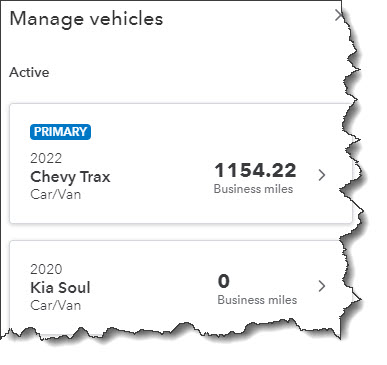
To get started, click the Mileage link in QuickBooks Online’s toolbar. The screen that opens will eventually display a table that contains information about your trips, but you need to do a little setup first. Click the down arrow next to Add Trip in the upper right corner and select Manage vehicles. A panel will slide out from the right. Click Add vehicle.
quickbooks online tips

You’ll need to supply information about your vehicles before you can start entering trips.

You’ll need to supply the vehicle’s year, make, and model. Do you own or lease it, and on what date was the vehicle purchased or leased and put into service? Do you want to have your annual mileage calculated by entering odometer readings or have QuickBooks Online track your business miles driven automatically? When you’re done making your selections and entering data, click Save.

Entering Trip Data

You can download trips as CSV files or import them from Mile IQ, but you’re probably more likely to enter them manually. Click Add Trip in the upper right corner. In the pane that opens, you’ll enter the date of the trip and either the total miles or start and end point. You’ll select the business purpose and vehicle and indicate whether it was a round trip. When you’re done, click Save. The trip will appear in the table on the opening screen, and your current possible total deduction will be in the upper left corner, along with your total business miles and total miles.

If you want to designate a trip as personal, click the box in front of the trip in that table. In the black horizontal box that appears, click the icon that looks like a little person, then click Apply. Now, the trip will appear in the Personal column and will not count toward your business tax-deductible mileage.

quickbooks online tips

When you select a trip in the Mileage table, you can mark it as personal so it’s not included in your business tax-deductible miles.

Personal Trips Can Count, Too

If you use your vehicle(s) for personal as well as business purposes, tracking some of those miles can also mean a tax deduction. For tax year 2022, you can deduct 18 cents per mile for your travel to and from medical appointments. Note: Medical mileage is only deductible if medical exceeds a certain percent of AGI. Be sure to check with the IRS yearly tax code, as they update the mileage amounts annually.

And if you do volunteer work for a qualified charitable organization, the miles you drive in service of it can be deducted at the rate of 14 cents per mile. You can also claim the cost of parking and tolls, as long as you weren’t reimbursed for any of these expenses. Obviously, the IRS wants you to keep careful records of your charitable mileage, and QuickBooks Online can provide them.

QuickBooks Online doesn’t track these deductions, but you’ll at least have a record of the miles driven.

Auto-Track Your Miles

The easiest way to track your mileage in QuickBooks Online is by using its mobile app. You can launch this and have it record your mileage automatically as you’re driving. Versions are available for both Android and iOS, and they’re different from each other. They also have more features than the browser-based version of QuickBooks Online, like maps, rules, and easier designation of trips as business or personal.

quickbooks online tips

The iOS version of Mileage in the QuickBooks Online app

In both versions, you’ll need to click the menu in the lower right corner after you’ve opened the QuickBooks Online app and select Mileage. Make sure Auto-Tracking is turned on. Your phone’s location services tool must be turned on, too. There are other settings that vary between the two operating systems. You can search the help system of either app to make sure you get your settings correct if the onscreen instructions aren’t clear enough.

Of course, you won’t see the fruits of your mileage deductions until you file your 2022 taxes. But you can factor these savings in as you’re doing your tax planning during the year. Please let us help if you’re having any trouble with QuickBooks Online’s Mileage tools, or if you have questions with other elements of the site.

Filed Under: QuickBooks

Avoiding Capital Gains Taxes with a 1031 Exchange

April 13, 2022 by admin

business documents on office table with smart phone and laptopSavvy investors can build wealth by deferring capital gains taxes via a 1031 exchange. Learn how it works and how it can help you as a real estate investor. For the in-depth information required to execute a 1031 exchange, a qualified intermediary is necessary.


What is a 1031 Exchange?

A 1031 exchange allows real estate investors to avoid paying capital gains taxes when selling an investment property and reinvesting in a replacement property. The name 1031 exchange comes from Section 1031 of the U.S. Internal Revenue Code.

A 1031 is also called a like-kind exchange. It is essentially a swap of one investment property for another. The “like-kind” refers to the fact that the properties in the exchange must be similar (i.e., of like kind) and the exchange property must be of equal or greater value as the property sold.

How Does a 1031 Exchange Work?

Under IRS code section 1031, which applies to real estate, investors can reinvest proceeds from the sale of one property into another property within a specified time frame to avoid paying capital gains taxes (the taxes on the growth of an investment when it is sold). Because it is rare for an even property swap to occur between parties, the most common type of exchange is the delayed “forward” exchange. In this case, the sold property funds are sent to a qualified intermediary and later used to acquire a replacement property from a seller.

What is a Qualified Intermediary?

A qualified intermediary facilitates a 1031 exchange. They hold the transaction funds from the sale of the first property until those funds are transferred to the seller of a replacement property. The qualified intermediary also prepares the legal documents required for the exchange. The qualified intermediary can have no formal relationship with the exchange parties outside of the exchange.

1031 Exchange Important Deadlines

  • The seller of the first property (the relinquished property) must identify a replacement property (their new investment property) within 45 days of the transfer of the relinquished property.
  • The replacement property must be received by the exchanger within either (1) 180 days of the date the exchanger transferred the first Relinquished Property or (2) the due date of the exchanger’s tax return for the year that the transfer of the first relinquished property occurs.
  • These are strict timelines and are not extended even if the 45th or 180th days fall on a weekend or holiday.

What You Need to Know about a 1031 Exchange

1031 exchange transactions should be handled by a professional qualified intermediary that is a third party (i.e., not a family member, friend, acquaintance, or business associate of either party involved in the exchange).

Exceptions

The IRS does not allow capital gains tax avoidance if the exchange:

  • is U.S. real estate for real estate in another country
  • involves property for personal use
  • is between related parties and either disposes of the property within two years

Why Do Investors Use a 1031 Exchange?

  • They can use what they would have paid in capital gains taxes to put more down on a replacement property to improve their buying power.
  • The savings on federal capital gains taxes could be 15 to 20 percent.
  • There could be savings at the state level (this varies by state, so your qualified intermediary should be consulted for this information).
  • The amount of income taxes paid could be reduced due to depreciation of the investment property.

A 1031 exchange is a tool that savvy real estate investors use to build wealth over time. To further understand how a 1031 exchange can benefit you, ask your CPA or accountant to help put you in touch with a qualified intermediary. Their guidance is critical in executing a 1031 whether you’re swapping two properties or working with a full portfolio of investment real estate properties.

Filed Under: Business Tax

Starting a Side Gig in 2022? Your New Tax Obligations

March 23, 2022 by admin

Woman Working From Home Using Laptop On Dining Table

It’s not just self-employed individuals who must pay estimated taxes. Here’s what you need to know.

W-2 income tax withholding isn’t perfect. You’ve probably had years when you owed more than you expected to on April 15. Or you were pleasantly surprised to receive a sizable refund. The idea, of course, is to try to come out as even as possible. You can usually do this by adjusting your withholding when you experience a life change like taking on a mortgage or having a baby.

Income taxes are also pay-as-you-go for self-employed individuals – or at least they should be. If you’re striking out on your own by starting your own small business in 2022 or you’re simply taking on a side gig to improve your finances, your tax obligation will change dramatically. Your income will not be subject to employer withholding every week or two. In most cases, you’ll get it all. But the IRS expects you to pay estimated taxes on that income four times a year.

Who Else Must Pay?

There are other situations where you’ll be expected to make quarterly payments. In fact, the only individuals who aren’t required to pay estimated taxes (besides W-2 employees whose withholding is on target) are those who meet all three of these conditions:

  • You owed no taxes the previous tax year (line 24 on your 2021 1040—total tax—is zero, or you weren’t required to file a return).
  • You were a resident alien or U.S. citizen for all of 2021.
  • Your 2021 tax year covered a 12-month period.

tax tips

You’ll find your total tax for 2021 on line 24 of the Form 1040. Notice, too, that line 26 asks for 2021 estimated tax payments.

There are numerous situations where individuals who have payroll taxes regularly withheld on their income may still be required to submit quarterly estimated taxes. For example, did you receive income from rents or royalties? Dividends or interest? Income from selling an asset? Gambling?

If you have an employer who withholds taxes, but you don’t think you’ll be paying enough given the deductions and credits you might receive, you need to plan for estimated taxes. Self-employed individuals are almost always required to submit them.

Special Rules for Some

As with all things IRS, there are many exceptions to the rules regarding estimated taxes. For example, there are special rules for:

  • Fishermen and farmers.
  • Some household employers.
  • Certain high-income taxpayers.
  • Nonresident aliens.

How Do You Estimate Your Quarterly Taxes?

That’s the hard part, especially if you’re new to the world of estimated taxes. There is no magic formula, no way to calculate to the penny what you’ll owe. You’re basically making an educated guess. Since you won’t know for sure what changes to the tax code will be put in place until the end of the year, you can’t be absolutely certain that you might get a particular credit or deduction.

But you know roughly what your income will be for a given quarter once you’re nearing the end of it. Do you have a lot of business-related expenses? Keeping track of those is critical, as they’ll offset your income. If you don’t, you’ll have to budget for a heftier quarterly payment. And you must keep in mind that you’ll be paying self-employment tax – that portion of your income taxes that your employer used to pay.

Once you’ve been self-employed for a full tax year and have seen what your tax obligation was, it will be easier to estimate in subsequent years. But you may have a difficult time your first year.

How Do You Pay Estimated Taxes?

tax tips

Individuals and business that had to pay estimated taxes in 2021 submitted the Form 1040-ES four times. If you’re self-employed in 2022, you’ll need to submit similar vouchers with your payments, unless you’re paying online.

If you’re self-employed and you anticipate owing $1,000 or more in taxes on your 2022 income, you’ll need to file quarterlies using IRS Form 1040-ES vouchers (available on the IRS website) along with a check or money order. There are also ways to pay online using a credit or debit card or direct bank withdrawal. Corporations would file the Form 1120-W if they expect to owe $500 or more.

Estimated taxes for the 2022 tax year are due:

April 18, 2022 (January 1-March 31, 2022)

June 15, 2022 (April 1-May 31, 2022)

September 15, 2022 (June 1- August 31, 2022)

January 16, 2023 (September 1-December 31, 2022)

A Challenging Task

Estimated taxes are not precise. And it may be difficult to set aside money for them if your income is not where you’d like it to be. But as you might expect, the IRS will levy penalties on you if you don’t.

Year-round tax planning can help you in this critical area. We’ll be happy to set aside time to consult with you about estimated taxes. We’re also available to do tax preparation and to look at how your taxes fit into your overall financial situation. Contact us soon to get a jump on the 2022 tax season — or to finish up 2021.

Filed Under: Business Tax

Cash Flow Strategies for Cash-Strapped Businesses

February 17, 2022 by admin

Businessman with cash dollars - business concept,computer and finance,investment,save.Cash is critical to the functioning of every business. Maintaining a healthy cash flow not only allows a company to meet its financial obligations but also gives it the flexibility to take advantage of emerging opportunities.

All too often, however, small businesses find themselves in a cash crunch, struggling to pay the bills and stay afloat. The good news is that businesses can take various measures to manage cash flow more effectively.

Controlling Expenses

A good place to start is by reviewing expenses to determine if there are areas where you can shave costs by contracting with another vendor or renegotiating existing contracts. Costs for ongoing goods and services, such as utilities, shipping, and telecommunications, should be reviewed frequently to see if expenses can be reduced. And when paying suppliers, consider whether it makes financial sense to take advantage of any early payment incentives that may be offered.

Keeping Debt in Check

Debt can be a useful tool if used properly, so be sure to keep it at a manageable level. Before your business takes on a new loan, reach out to multiple lenders and compare the terms they offer. When acquiring equipment, consider whether leasing may be a better option than borrowing money to finance its purchase. For short-term financing needs, a line of credit is a helpful tool. The lender will base interest charges only on the amount your business draws from the credit line.

Managing Inventory

Maintaining excessive inventory can tie up cash unnecessarily. If your business carries inventory, avoid overstocking. Your inventory management system should be able to indicate the minimum quantities that you need to keep on hand in order to meet your customers’ needs.

Simplifying Billing and Collections

Employees who handle billing and collections should have specific, clear guidelines. By standardizing the process, you help ensure your business will be paid promptly. You can speed up payments by offering discounts for early payment or by encouraging your customers to pay using electronic funds transfer. To help minimize the problem of unpaid accounts, consider making follow-up calls or sending email or text message reminders within a set period after you have provided goods or services or when a bill’s due date passes. Minimizing Taxes When Possible

Deductions and credits can help your business limit its tax burden and boost its cash flow. A knowledgeable tax professional can keep you informed of any special tax breaks that may be of value to your business, such as the energy credit for the acquisition of various types of alternative energy property.

Make Planning a Priority

Identifying the causes of reduced cash flow and taking steps to rectify a cash flow crunch is critical to the ongoing success of your business. Proper cash flow planning can help you make better use of budgets and employ financing and capital more effectively to increase revenues as well as boost profits. If erratic cash flow is a recurring issue for your business, it can be helpful to gain the insights and the input from an experienced financial professional.

Filed Under: Business Best Practices

Small Businesses Facing Labor Shortages

January 18, 2022 by admin

Two Businesswomen Meeting In OfficeSmall business owners cite the unavailability of workers as one of their biggest challenges1. The labor shortage means that employers cannot, in some circumstances, operate at full capacity and must forgo some revenue opportunities. Businesses may have to delay planned expansions or the addition of new products or services because of the scarcity of workers.

Employers understand that having a skilled, trained, and committed workforce is key to growth and profitability. In the competition for a decreasing pool of skilled employees, employers have to assess their current hiring practices, identify any deficiencies, and develop and implement policies that help ensure that they can hire the employees they need when they need them.

Here are some issues employers need to consider when developing a strategy to attract and retain key employees.

Sharpen Your Hiring Process

Use every available tool. If you are not using social media to reach out and contact potential hires, you are not taking advantage of a very helpful medium. Social networks like LinkedIn and Facebook can be productive resources. They can be particularly effective if you ask family members, friends, and current employees to reach out and talk up job opportunities with your company on the sites they frequent.

Posting available positions prominently on your company website can also be effective in reaching out to a pool of potential hires. Traditional avenues, such as headhunters and employment agencies as well as radio and television ads, remain helpful.

Revisit Your Compensation

Some industries, such as information technology, pay more in wages and benefits than other traditionally low-paying industries, such as food services and retail. Still, if the job opening you want to fill is critical to the future growth of your business, you may want to consider paying above market salary if you can afford to do so. You may even have to get into a bidding war with other employers.

The reality is that employees with in-demand skills typically command a premium salary. Before you make a prospective employee an offer, find out how much other employers in your area pay for similar jobs. One place you can find useful employment and wage statistics is the Bureau of Labor Statistics website (bls.gov). The BLS information covers most geographical areas in the United States and is broken into type of occupation as well as various levels within that occupation.

Rethink Benefits

Most employees look for health care coverage, paid vacation days, and an employer-provided retirement plan. If you can’t be competitive with these benefits, you may have to step it up with others. Think of offering employees the chance to work remotely for a few days a week if it is feasible with your business’s operations. Consider summer hours, employer-provided snacks and drinks, and casual dress days.

Coping With a Labor Shortage

Not every incentive has to have a price tag attached. Non-monetary awards — from recognizing an “employee of the month” to a heartfelt face-to-face expression of gratitude for a job well done — can be remarkably constructive and can leave a lasting impact on employees. Inexpensive incentives can include gift certificates, cash spot awards, and even extra paid vacation days.

Offer Training

While costly, offering courses and educational opportunities that can help employees advance in their area of expertise is a potent way to attract ambitious, committed employees. Courses that develop well-rounded team players who can take on other roles within your business are especially cost-effective in the long run.

Consider Incentive Plans

Incentive plans reward employees for their achievements and create a sense of accomplishment. Plans can be used on a one-time basis or as an ongoing program. Some incentive plans include:

  • Annual incentive plan: Rewards for this type of plan are tied to expected results that are identified at the beginning of the performance cycle.
  • Discretionary bonus plan: The owners/managers determine the size of the bonus pool and the amounts that will be given to individuals after a performance period. Typically, payouts from this type of plan are not guaranteed, nor is there a predetermined formula.
  • Profit sharing plan: A profit sharing plan allows employees to share in their employer’s profits. Such plans typically include a predetermined formula for allocating profit shares among participating employees and for distributing funds accumulated under the plan. Some plans are tied in with the employer-provided retirement plan and some plans are discretionary.

Work With Your Financial Professional

Structuring an effective compensation and incentive package can be a complex and time-consuming task. The help of an experienced financial professional can be invaluable during every stage of this undertaking.

1″The America Works Report: Quantifying the Nation’s Workforce Crisis,” U.S. Chamber of Commerce, June 1, 2021.

Filed Under: Business Best Practices

Small Business Taxes: Who Pays What?

December 13, 2021 by admin

Handsome young businessman workingThere are various federal taxes that may apply to your small business. The type and form of business you operate determines what taxes you must pay and how you pay them. At the federal level, several different taxes may apply.

Excise Taxes

The IRS defines an excise tax as a tax imposed on the sale of specific goods or services, or on certain uses. Federal excise tax is typically imposed on the sale of items such as tobacco, fuel, alcohol, tires, heavy trucks and highway tractors, and airline tickets. Many excise taxes are placed in trust funds for projects related to the taxed product or service, such as highway or airport improvements.

An excise tax may be imposed at the time of import, sale by the manufacturer, sale by the retailer, or use by the manufacturer or consumer. Some excise taxes are collected by a third party, which then must remit the taxes to the IRS in a timely manner. An example of a third-party collector of an excise tax is a commercial airline, which collects the excise taxes on airline tickets that are paid by airline passengers. Businesses that are subject to federal excise taxes must generally file Form 720, Quarterly Federal Excise Tax Return. Certain excise taxes, such as those owed to the Alcohol and Tobacco Tax and Trade Bureau, are reported on different forms.

Income Taxes

Income taxes must be paid on business profits. How that tax is paid depends on how the business is structured. Most small businesses are pass-through entities, which means that the business’s profits or losses are passed through to the owners and reported on their personal income tax returns.

Partnerships and multi-member limited liability companies (LLCs) generally file a partnership business tax return for informational purposes only. The individual partners and LLC members pay income taxes for their share of the income of the business. Note, however, that some LLCs elect to be treated as a corporation for tax purposes.

An S corporation files an S corporation income tax return for the business. Like a partnership, an S corporation’s net income is divided among the owners, who pay tax on their share of that income individually.

A sole proprietor reports business profit or loss on a separate schedule filed with the sole proprietor’s individual income tax return. Unless an election to be treated as a corporation has been made, the owner of a single-member LLC also reports the company’s profit or loss directly on the owner’s return.

Social Security and Medicare Taxes

Employers must generally withhold Social Security and Medicare taxes from their employees’ wages and must pay a matching amount. Employers must also withhold the 0.9% additional Medicare tax on employee wages and compensation that exceeds a threshold amount.

Self-Employment Taxes

Self-employment tax is a Social Security and Medicare tax primarily for individuals who work for themselves. It is similar to the Social Security and Medicare taxes paid for other workers.

Federal Unemployment Tax

Employers are required to report and pay the Federal Unemployment Tax Act (FUTA) tax separately from federal income taxes and Social Security and Medicare taxes. FUTA tax is not withheld from wages; employers are responsible for paying the tax.

Business owners should exercise extreme care when it comes to paying taxes since any mistakes on their part could result in significant penalties. For assistance, consult a tax professional.

Filed Under: Business Tax

  • « Previous Page
  • Page 1
  • …
  • Page 6
  • Page 7
  • Page 8
  • Page 9
  • Page 10
  • …
  • Page 14
  • Next Page »

Primary Sidebar

Search

Archives

  • March 2026
  • February 2026
  • January 2026
  • December 2025
  • November 2025
  • October 2025
  • September 2025
  • August 2025
  • July 2025
  • June 2025
  • May 2025
  • April 2025
  • March 2025
  • February 2025
  • January 2025
  • December 2024
  • November 2024
  • October 2024
  • September 2024
  • August 2024
  • July 2024
  • June 2024
  • May 2024
  • December 2023
  • November 2023
  • October 2023
  • September 2023
  • August 2023
  • July 2023
  • June 2023
  • May 2023
  • April 2023
  • March 2023
  • February 2023
  • January 2023
  • December 2022
  • November 2022
  • October 2022
  • September 2022
  • August 2022
  • July 2022
  • June 2022
  • May 2022
  • April 2022
  • March 2022
  • February 2022
  • January 2022
  • December 2021
  • November 2021
  • October 2021
  • September 2021
  • August 2021
  • July 2021
  • June 2021
  • May 2021
  • April 2021
  • March 2021
  • February 2021
  • January 2021
  • December 2020
  • November 2020
  • October 2020
  • September 2020
  • August 2020
  • July 2020
  • June 2020
  • May 2020
  • April 2020
  • March 2020
  • February 2020
  • January 2020
  • December 2019
  • November 2019
  • October 2019
  • September 2019
  • August 2019
  • July 2019
  • June 2019
  • May 2019
  • April 2019
  • March 2019
  • February 2019
  • January 2019

Categories

  • Business Best Practices
  • Business Tax
  • Estate and trusts
  • Events
  • Individual Tax
  • Investment
  • QuickBooks
  • Real Estate
  • Retirement
  • Tax Tips
  • Uncategorized

Copyright © 2021 · https://www.dorseycpa.com/blog